
Understanding the fundamental patterns behind effective AI communication.
Introduction
Prompting isn't just about asking questions, it's about structuring thought and communicating intent in a way that leverages how AI systems process and generate information. This document breaks down the core philosophicalV patterns that underlie all effective prompts, providing you with mental frameworks rather than just templates.
The Fundamental Reality: You Are Programming a Machine
Stop thinking of AI as a person. Start thinking of it as a very sophisticated computer that you program with words instead of code.
This is perhaps the most important mental shift you can make. When you anthropomorphize AI, treating it like a human colleague, friend, or assistant, you set yourself up for frustration and poor results. Here's why:
AI Is Not Human
It doesn't have feelings to hurt or moods to manage
It doesn't get tired or need encouragement
It doesn't have intuition about what you "really" meant
It doesn't remember your previous conversations unless explicitly told
It doesn't care about being polite or social niceties
AI Is a Probability Engine
What AI actually does is pattern match against billions of examples and predict the most statistically likely next tokens based on your input. Think of it as:
A very advanced autocomplete that works on entire thoughts, not just words
A pattern matching machine that finds statistical relationships in vast datasets
A sophisticated function that transforms input (your prompt) into output (generated text)
A probability calculator that weighs different possible responses
Programming Mindset vs. Conversation Mindset
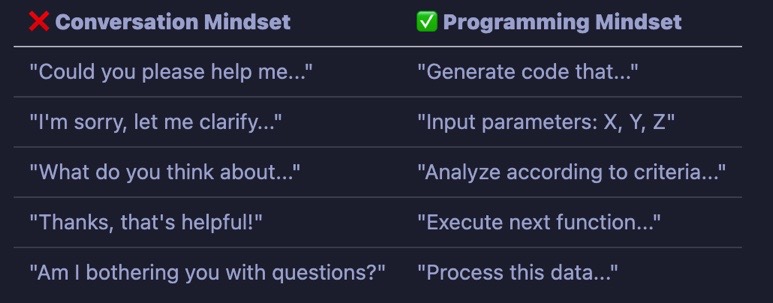
Why This Matters for Prompting
When you think of prompting as programming, you:
Write more precise instructions instead of hoping the AI "gets it"
Specify exact parameters rather than assuming context
Debug systematically when results aren't what you expected
Iterate logically based on input/output analysis
Focus on clarity over politeness
The Programming Analogy
# Bad function call (conversation mindset)
result = ai("Um, could you maybe help me write some code?
            I'm not sure exactly what I need but...")

# Good function call (programming mindset)
result = ai(
    task="generate_authentication_function",
    language="python",
    framework="flask",
    requirements=["JWT tokens", "bcrypt hashing", "rate limiting"],
    output_format="production_ready_with_tests"
)
Practical Implications
Don't apologize for asking follow-up questions
Don't thank the AI (it doesn't care and wastes tokens)
Don't explain your feelings about the task
Don't worry about being "rude" by being direct
Do be extremely specific about what you want
Do treat each prompt as a function call with parameters
Do debug methodically when output doesn't match expectations
This doesn't mean being cold or mechanical—it means being precise and intentional. You're not managing a relationship; you're optimizing a system.
The Five Fundamental Prompt Archetypes
After analyzing thousands of successful prompts across domains, five core patterns emerge. Each represents a different mode of thinking and requires a distinct approach to achieve optimal results.
The Creator Archetype
Philosophy
"I know what I want to exist, but I need you to bring it into being."
The Creator prompt is about manifestation through specification. You have a clear vision of the end result but need the AI to execute the transformation from concept to reality.
Mental Model
Think of yourself as an architect providing blueprints. The more precise your specifications, the closer the AI gets to your vision. The AI becomes your skilled craftsperson who can execute but needs clear direction.
Structure Framework
VISION: [What you want to exist]
CONSTRAINTS: [Boundaries and requirements]
CONTEXT: [Why this matters/who it's for]
STYLE: [How it should feel/sound/look]
SUCCESS: [How you'll know it's right]
Examples & Deconstruction
Weak Creator Prompt:
"Write some code for user authentication"
Strong Creator Prompt:
VISION: A secure user authentication system for a Node.js/Express API CONSTRAINTS: Must use JWT tokens, bcrypt for passwords, rate limiting CONTEXT: Handling sensitive financial data, users are mobile app developers STYLE: Clean, well-commented, follows REST conventions SUCCESS: Ready to deploy with comprehensive error handling and logging
Why This Works
Specificity reduces ambiguity - fewer decision points for the AI to guess wrong
Context provides wisdom - AI can make better micro-decisions when it understands the bigger picture
Success criteria enable self-correction - AI can evaluate its own output against your definition of "right"
Common Pitfalls
Over-specifying implementation details while under-specifying outcomes
Assuming AI knows your context without stating it explicitly
Forgetting to define "done" - leading to endless iterations
The Analyzer Archetype
Philosophy
"Help me understand what I'm looking at and what it means."
The Analyzer prompt is about insight extraction and pattern recognition. You have data, information, or a situation, and you need the AI to find meaning, patterns, or implications you might miss.
Mental Model
Think of the AI as a consulting expert who can quickly pattern-match across vast domains of knowledge. Your job is to frame the analysis and define what kinds of insights you're seeking.
Structure Framework
SUBJECT: [What you want analyzed]
PERSPECTIVE: [What lens/expertise to apply]
FOCUS: [Specific aspects to examine]
DEPTH: [How detailed/surface-level]
OUTPUT: [Format of insights you want]
Examples & Deconstruction
Weak Analyzer Prompt:
"Look at this code and tell me what's wrong"
Strong Analyzer Prompt:
SUBJECT: This Python function that's causing memory leaks in production PERSPECTIVE: Senior developer focused on performance and resource management FOCUS: Memory allocation patterns, potential leaks, optimization opportunities DEPTH: Deep technical analysis with specific line-by-line recommendations OUTPUT: Prioritized list of issues with severity ratings and fix suggestions
Why This Works
Perspective priming activates relevant knowledge domains in the AI
Focus prevents scatter - AI won't waste effort on irrelevant aspects
Depth specification calibrates the thoroughness appropriately
Output format ensures you get actionable insights, not just observations
Common Pitfalls
Analysis paralysis - asking for too many perspectives simultaneously
Context starvation - not providing enough background for meaningful analysis
Vague success criteria - not specifying what would make the analysis valuable
The Guide Archetype
Philosophy
"I need to know how to do something, and I need you to teach me the way."
The Guide prompt is about knowledge transfer and capability building. You want to learn a process, understand a concept, or develop a skill. The AI becomes your patient teacher.
Mental Model
Think of the AI as a master craftsperson teaching an apprentice. Your job is to specify your current level, define your learning goals, and choose your learning style. The AI adapts its teaching to your needs.
Structure Framework
CURRENT: [Your current knowledge/skill level]
GOAL: [What you want to be able to do]
LEARNING: [How you learn best]
CONSTRAINTS: [Time, resources, prerequisites]
VALIDATION: [How you'll practice/confirm understanding]
Examples & Deconstruction
Weak Guide Prompt:
"How do I use Docker?"
Strong Guide Prompt:
CURRENT: Familiar with VMs and basic command line, never used containers GOAL: Deploy a multi-service web application using Docker Compose LEARNING: Hands-on examples, prefer understanding concepts before memorizing commands CONSTRAINTS: Need to be productive within 2 weeks, using macOS development environment VALIDATION: Successfully containerize my existing Node.js + PostgreSQL app
Why This Works
Level calibration prevents too-basic or too-advanced explanations
Goal clarity shapes the entire learning path
Learning style matching improves retention and engagement
Constraint awareness keeps advice practical and achievable
Validation planning ensures actual skill transfer, not just information transfer
Common Pitfalls
Underestimating current knowledge - getting overly basic explanations
Overestimating current knowledge - getting lost in advanced concepts
Vague goals - learning "about" something instead of learning "to do" something
No practice plan - consuming information without building capability
The Counselor Archetype
Philosophy
"I have a decision to make or problem to solve, and I need wisdom to choose well."
The Counselor prompt is about decision support and problem-solving wisdom. You're facing uncertainty, trade-offs, or complex situations where you need the AI to help you think through implications and options.
Mental Model
Think of the AI as a wise advisor who can see multiple perspectives and long-term consequences. Your job is to frame the dilemma, surface your constraints, and clarify your values so the AI can provide wisdom that aligns with your priorities.
Structure Framework
SITUATION: [Current state and the decision/problem]
OPTIONS: [Alternatives you're considering]
STAKES: [What matters most/what you're optimizing for]
CONSTRAINTS: [Limitations, non-negotiables, resources]
CONCERNS: [What you're worried might go wrong]
Examples & Deconstruction
Weak Counselor Prompt:
"Should I use microservices or a monolith?"
Strong Counselor Prompt:
SITUATION: Building a new e-commerce platform, team of 8 developers, 6-month timeline to MVP OPTIONS: Start with monolith and split later vs. microservices from day one vs. modular monolith STAKES: Speed to market is critical, but we need to scale to millions of users within 2 years CONSTRAINTS: Limited DevOps expertise, tight budget, regulatory compliance requirements CONCERNS: Wrong choice could delay launch or create technical debt that kills us later
Why This Works
Situation context helps AI understand the full complexity
Explicit options prevent the AI from solving the wrong problem
Stakes clarification helps AI weight different factors appropriately
Constraint honesty keeps advice realistic and implementable
Concern surfacing ensures risks are addressed, not ignored
Common Pitfalls
Binary thinking - presenting only two options when more exist
Hidden constraints - not revealing important limitations that affect the decision
Unclear priorities - wanting to optimize for everything simultaneously
Seeking confirmation rather than genuinely wanting counsel
The Collaborator Archetype
Philosophy
"Let's work together to make this better than either of us could alone."
The Collaborator prompt is about iterative co-creation and refinement. You have something that exists but needs improvement, or you want to brainstorm and build ideas together. This is the most dynamic archetype.
Mental Model
Think of the AI as a creative partner in a jam session. You bring ideas, the AI riffs on them, and together you create something neither could have alone. Success requires clear communication loops and shared ownership of the outcome.
Structure Framework
STARTING POINT: [What exists now]
DIRECTION: [What kind of improvement/change you want]
PARTNERSHIP: [What you're bringing vs. what you need from AI]
ITERATION: [How you want to work together]
ENDPOINT: [How you'll know when you're done]
Examples & Deconstruction
Weak Collaborator Prompt:
"Make this function better: [code dump]"
Strong Collaborator Prompt:
STARTING POINT: This authentication function works but feels clunky and has edge case bugs DIRECTION: More elegant, handles errors gracefully, easier to test and maintain PARTNERSHIP: I'll provide domain knowledge and test edge cases, you bring fresh perspective on structure ITERATION: Let's go through it section by section, I'll give feedback on each improvement ENDPOINT: Code that I'm proud to show senior developers and that handles production edge cases
Why This Works
Starting point acknowledgment respects existing work and builds from it
Direction clarity prevents aimless changes
Partnership definition establishes roles and expectations
Iteration planning creates a feedback loop for continuous improvement
Endpoint clarity prevents endless tweaking
Common Pitfalls
Passive collaboration - expecting AI to do all the work
Unclear ownership - not defining who's responsible for what
No stopping criteria - iterating forever without clear "done" definition
Feedback avoidance - not providing clear reactions to AI suggestions
Advanced Patterns: Combining Archetypes
The Sequential Pattern
Use multiple archetypes in sequence for complex tasks:
Analyzer to understand the current state
Counselor to decide on approach
Creator to build the solution
Collaborator to refine it
The Parallel Pattern
Use multiple perspectives simultaneously:
"Analyze this code from both a security and performance perspective"
"Create a solution that works for both junior and senior developers"
The Meta Pattern
Have the AI choose the archetype:
"What type of help do I need for this situation: analysis, creation, guidance, counsel, or collaboration?"
The Universal Principles
Regardless of archetype, these principles always apply:
1. Specificity Beats Generality
Concrete details produce better results than vague descriptions.
2. Context Is King
AI performs better when it understands why something matters.
3. Constraints Enable Creativity
Boundaries help AI focus its capabilities productively.
4. Examples Clarify Intent
Show, don't just tell, what you want.
5. Iteration Improves Outcomes
Great results come from conversation, not single prompts.
Practical Application Framework
Before Prompting: The SCARE Analysis
Situation: What's the current state?
Challenge: What needs to change or be solved?
Archetype: Which prompt type fits this need?
Result: What would success look like?
Engagement: How will you interact with the AI to get there?
During Prompting: The CLEAR Method
Context: Set the stage
Limit: Define boundaries
Example: Show what you mean
Ask: Make the specific request
Refine: Iterate based on results
After Prompting: The VALUE Check
Valid: Is the output factually correct?
Appropriate: Does it fit your context and constraints?
Likely to work: Is it practical and implementable?
Useful: Does it solve your actual problem?
Excellent: Is it the quality you need?
Mastery Through Practice
Progressive Skill Building
Novice: Learn to identify which archetype fits your need
Advanced: Combine archetypes fluidly within conversations
Expert: Design prompt sequences that build complex outcomes
Master: Teach others to think in prompt patterns, not just templates
Signs of Prompting Mastery
You rarely get unexpected or off-topic responses
You can recover quickly when prompts don't work as expected
You help others improve their prompting by diagnosing their archetype choice
You create novel combinations that produce breakthrough results
Conclusion
Effective prompting isn't about memorizing templates—it's about understanding the fundamental modes of interaction between human intent and AI capability. When you master these five archetypes, you gain the ability to think with AI rather than just ask things of AI.
The future belongs to those who can collaborate effectively with AI systems. These philosophical frameworks give you the mental models to do exactly that.
Remember: The goal isn't to prompt perfectly, but to prompt intentionally. Every interaction is an opportunity to refine your understanding of how to think and communicate with artificial intelligence.